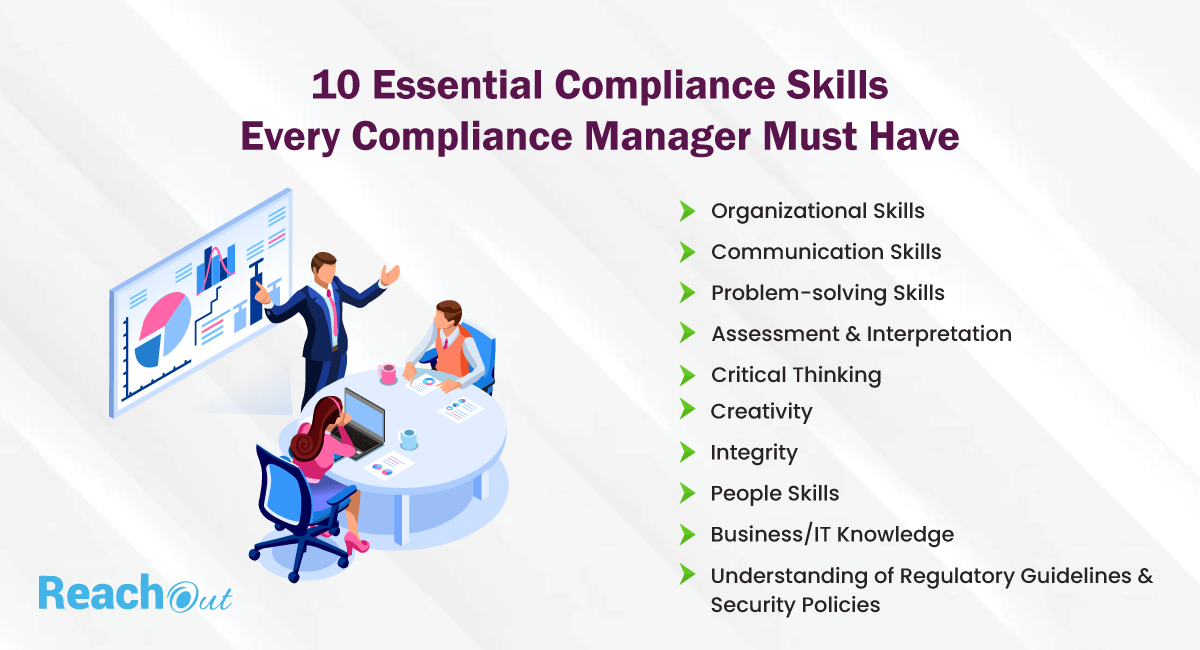
10 Essential Skills Every Compliance Manager Must Have!
The compliance manager is like the company’s rulekeeper. Their main job is to ensure that the company acts ethically and follows all the laws and regulations. This helps maintain the company’s good reputation and avoids any legal trouble.
Now, here’s why it’s so crucial. A study by the Ponemon Institute states that the global cost of compliance failures reached a staggering $6 trillion in 2020 alone. Data privacy breaches alone continue to sting, with an average cost of $4.35 million in 2023, according to an IBM report.
In this article, we list the essential skills that compliance managers or officers should have to remain successful.
- Excellent Organizational Skills
- Proficient Communication Skills
- Effective Problem-solving
- Assessment & Interpretation
- Critical Thinking Ability
- Creativity
- Integrity
- Strong People Skills
- Up-to-date Knowledge of Business Technology and IT
- Sound Understanding of Regulatory Guidelines and Security Policies
Who is a compliance manager?
Compliance managers assess risks, conduct check-ups, and identify any problems with following the rules. They also make sure written and spoken company policies are clear and followed. This helps prevent issues and keeps the company’s reputation clean.
A compliance manager makes sure a company’s operations follow relevant laws, regulations, and internal policies. The role often works closely with legal, risk, and audit teams. Legal teams interpret the law, audit teams check whether processes are being followed, and compliance managers help turn regulatory requirements into practical policies and procedures that employees can follow in their day-to-day work.
What does a compliance manager do?
Here are some key tasks they handle:
- Assessing business risks.
- Checking if standards are being followed through audits.
- Spotting any compliance issues.
- Making sure all organizational policies and regulations are followed.
- Developing strategies to manage risks.
- Investigating compliance procedures and taking the necessary actions.
- Monitoring regulatory requirements as they change.
- Developing and updating internal policies.
- Training employees on compliance requirements.
- Reporting findings to leadership.
- Maintaining documentation and audit trails.
Most of these responsibilities are ongoing. Policies and procedures can become outdated as regulations, business operations, and enforcement priorities change. Compliance managers therefore need to review processes regularly, follow up on findings, and confirm that corrective actions have been completed.
To ensure strict compliance, compliance managers rely on systems and procedures, with service management software being a common tool.
This software assists in planning training, tracking documents, and staying current on regulations, ultimately streamlining their work and allowing them to focus on larger tasks, thus maintaining smooth company operations.
Related reading: A Complete Guide to Field Service Management
Coveted Skills for Compliance Managers
To effectively carry out their tasks and achieve desired results, compliance managers need specific skills and expertise.
They need a well-rounded skillset that combines technical knowledge with strong communication and problem-solving abilities. The exact mix depends on the industry and organization, but the following skills help compliance managers interpret requirements, assess risks, work with stakeholders, and maintain reliable records.
Here are the top skills for compliance managers:
-
Organization Skills
Compliance managers need to juggle multiple tasks within set deadlines. They should ensure all employees are aware of the rules and regulations for maintaining compliance within the organization. Before starting the compliance process, clear goals should be established and achieved within a specific schedule.
Compliance managers must have a clear plan of action, knowing what needs to be done, how, and when. Breaking down inspections or audits into smaller tasks and assigning them can also be beneficial.
-
Communication Skills
Just like many other jobs, compliance managers need good written and verbal communication skills. They also require interpersonal skills such as listening and decision-making to conduct compliance processes effectively. Compliance officers need to reflect on and clarify regulatory topics.
Quality communication skills are crucial for keeping all sectors and resources aligned with compliance requirements. Effective communication is essential for sharing audit findings in a report.
-
Problem-Solving Skills
Problem-solving for compliance officers involves using both creative and analytical thinking. They often deal with challenges like unclear regulations, cost issues, and potential business failures. Field officers must identify risks associated with policy-making to find simple solutions.
Implementing and monitoring solutions is crucial for effective problem-solving. It’s important to follow planned steps and provide feedback on chosen solutions. Auditors should also have a good understanding of business and make sound judgments on what to do next.
-
Assessing and Interpreting Risks
The risk management process has several key steps: identification, analysis, planning, monitoring, reporting, and control. Compliance managers need to understand and follow these steps.
According to Deloitte’s Compliance Risk Assessment report, a comprehensive compliance risk evaluation includes a framework and methodology for assessing and prioritizing risks. This is part of a compliance management system that integrates all processes, from documentation to tools, to ensure organizations follow standardized procedures and guidelines.
Learning from past regulatory mistakes helps prevent future non-compliance. To assess compliance risks effectively, compliance managers need a solid understanding of regulatory concepts and their relevance to the business. Risk management involves statistical analysis, so managers must be able to evaluate risks and understand their legal, financial, business, and reputational implications for the organization.
Related Reading: How to Put Together an Effective Audit Program
-
Critical Thinking
Critical thinking is a valuable skill for compliance managers. They need to think rationally and clearly when analyzing risks. For auditors, critical and analytical thinking is crucial for analyzing data and providing strategic input.
According to a report by KPMG, critical thinking is among the top skills needed for internal auditing. The report highlights foundational essentials for a critical thinking approach to audits, including:
- Open-mindedness
- Situation analysis
- Providing context
- Brainstorming
- Concluding
Compliance managers should offer practical solutions to address problems. They need to think reflectively and independently, understanding the logical connection between business policies and compliance regulations.
Related Reading: Find 6 Tips To Prevent Common Maintenance Manager Mistakes.
-
Creativity
Creative skills are essential for compliance managers. They need to grasp compliance risks and regulatory measures within the business. Creativity helps them identify connections between seemingly unrelated risk analysis and decision-making.
Being creative allows compliance managers to generate solutions for unique compliance issues. They need creativity and innovation to blend current business processes with effective compliance and audit inspections and reports.
-
Integrity
Integrity is a must for any profession. Compliance managers are no exception. The regulation management process can only be implemented and accomplished effectively if the officers carrying out the inspection reports have strong moral principles and honest quality.
They should uphold being in an undivided and unbiased state while executing their tasks. Compliance managers should be trustworthy. They should also have confidence and resilience when faced with tough situations and dealing with audit reports.
-
People Skills/Relationship Building
Understanding people and staying calm are vital skills for auditors. This helps compliance officers gain trust and credibility with clients. Compliance managers need to be approachable and avoid being confrontational or aggressive.
By grasping company situations, responding to mistakes appropriately, and empathizing well, compliance officers can fulfill compliance policies effectively. Building relationships with clients and companies fosters trust, respect, and productive interactions.
Related Reading: Learn how your Field Staff is your secret weapon to improve sales and revenue.
-
IT Knowledge
Understanding the latest business technologies and IT requirements is crucial for compliance managers. It not only ensures smooth audit sessions but also helps them advance in their careers. Continuous learning and teamwork are facilitated by this knowledge.
According to Accenture’s Compliance Risk Study, there is a growing demand for compliance officers who are digitally savvy, analytical, and proactive in addressing the challenges of the digital age.
Having sharp business acumen is essential for compliance officers. This includes being adaptable to different audit environments and being flexible about regulatory errors. IT knowledge is also important for auditors, combining accounting with technical expertise.
Mastery of primary IT tools, especially service management software, is vital. Additional training through platforms can greatly enhance compliance managers’ understanding of business technologies, IT tools, and the latest regulatory policies.
-
Knowledge About Vulnerability/Security
Understanding security policies is crucial for compliance managers to ensure successful audit processes. They need to identify potential vulnerabilities and discuss prevention measures or repair steps based on the audit report’s status. Compliance managers should be familiar with various security standards, such as ISO standards, interception regulations, and control policies.
Their role includes overseeing compliance programs and efficiently generating audit reports. To achieve a perfect compliance process, compliance officers must adhere to the skills mentioned above. They should follow general principles for each skill set and ensure compliance with all relevant rules, laws, and regulations while respecting the diverse roles and responsibilities within a firm.
Compliance manager skills: hard skills vs. soft skills
Compliance managers need both technical knowledge and professional skills. Hard skills help them interpret requirements, assess risks, maintain records, and use compliance tools. Soft skills help them communicate findings, build trust, make decisions, and work with teams.
Compliance manager requirements and qualifications
Most roles ask for a bachelor’s degree in business, law, finance, or a related field. This depends a lot on the industry; banking and healthcare tend to be stricter about it than others. Experience in audit, risk, or legal work often counts for as much as the degree, sometimes more. Compliance in pharma doesn’t look like compliance in fintech even though a lot of the underlying skills are the same.
Certifications can help if they’re relevant to the industry, things like anti-money laundering or information security credentials. Not always a hard requirement, though.
Employers may also value experience with audit planning, project coordination, data analysis, reporting, and process improvement. The exact requirements depend on the role, sector, and level of responsibility, so candidates should check the qualifications listed in relevant job descriptions.
How to develop compliance manager skills
- Regulatory knowledge: Follow updates at the source and practice applying them to real business decisions, not just summarizing what changed.
- Risk assessment: Practice identifying risk, likelihood, impact, and controls using real or past cases, including ones outside your own industry.
- Communication: Practice explaining complex requirements in plain language for people outside compliance, and ask them to repeat it back to you.
- Technology: Get comfortable with spreadsheets, reporting tools, GRC platforms, and how AI gets used in the business. This list keeps growing.
- Organization: Use a clear process to track deadlines, assigned owners, evidence, audit findings, and corrective actions.
- Problem-solving: Review past incidents to understand root causes and assess whether the actions taken prevented the issue from recurring.
- Ethical judgment: Practise documenting decisions clearly and applying policies consistently, including in difficult situations.
Emerging compliance skills for 2027
Compliance work continues to evolve as organizations adopt new technologies and respond to changing requirements. In addition to the core skills above, compliance managers may benefit from developing:
- AI governance and access control: Understand how AI systems are used in the organization, what data they can access, and what oversight is required.
- Data analysis and reporting: Use data to identify trends, recurring findings, and areas that may need further review.
- RegTech and GRC platforms: Understand how digital tools can support monitoring, documentation, risk tracking, and reporting.
- Change management: Help teams understand and adopt updated policies, controls, and procedures.
- Cross-functional collaboration: Work with legal, IT, security, operations, HR, and leadership to address risks across departments.
These are additions to-not replacements for-the fundamentals of regulatory knowledge, sound judgment, communication, and risk-based decision-making.
How digital tools support compliance work
Compliance work involves a lot of inspections, checklists, documentation, corrective actions, and audit trails. When these get tracked across spreadsheets and email threads, things get lost. It isn’t always obvious until an audit turns up a gap nobody noticed.
ReachOut Suite’s inspection tools cover this. Digital forms and predefined checklists for recurring inspections, photo and file attachments for evidence, scheduling for repeat audits, corrective action tracking, and audit reports that hold up when someone actually asks to see them.
If your team is still tracking this across spreadsheets and email, that’s often where things start slipping. ReachOut Suite is built to handle this kind of workflow instead.
Digital tools can help teams standardize how inspections are completed and keep relevant records together. They support the workflow, but compliance managers remain responsible for confirming that the process reflects applicable requirements and that the evidence is complete and accurate.
To improve compliance managers’ capabilities, utilizing specialized field service software like ReachOut Suite can be beneficial. This software offers a variety of features, such as checklists and paperless forms, to facilitate easy management. Contact us now to learn more!
Frequently Asked Questions
1. What are the most important skills for a compliance manager?
Regulatory knowledge, risk assessment, communication, and ethical judgment tend to matter most. The exact mix shifts by industry. Organization, critical thinking, problem-solving, and technology skills also help managers put requirements into practice.
2. What skills are needed to become a compliance manager?
A working knowledge of relevant regulations, risk assessment ability, and strong communication, usually built through experience in audit, risk, or legal roles.
3. What is the role of a compliance manager?
Making sure a company’s operations comply with relevant laws, regulations, and internal policies, while working closely with legal, risk, and audit teams.
4. What does a compliance manager do?
Monitors regulations, assesses risk, coordinates audits, develops policy, trains staff, investigates issues, and reports to leadership.
5. What is the difference between a compliance manager and a compliance officer?
The titles get used a lot interchangeably. Sometimes “officer” refers to a more senior or company-wide role while “manager” is more team or department level, though this really comes down to how a specific company sets up its org chart.
Digitize your field service operations from scheduling to invoicing with ReachOut. Connect your technicians with the companion mobile app to execute jobs and reduce paperwork in the field. Try ReachOut now and give your customers the fast and quality service they deserve.
Get Started

Aarathy
With over a decade of experience in the technology sector, Aarathy is passionate about improving field service efficiency through digital innovation. She is particularly interested in topics such as field service trends, service automation, and strategies for implementing digital transformation in service management.
More posts by Aarathy
Related Posts

How to Start and Operate a CCTV Business Successfully?
With more customers realizing the benefits of having CCTVs installed,...

Technician Management Software Cyprus: Why It’s Time to Move Beyond WhatsApp
Most service businesses in Cyprus start out managing technicians the...

6 Points to Remember While Commencing and Sustaining a Fire Extinguisher Business
A Handy Guide to Kick-Starting and Running a Fire Extinguisher...